
×

Updated: Wed, 25/02/2026
One of the most common conversations we have with clients is around downlight specification. The comparative specification numbers on a product data sheet between a higher end and budget choice can look similar enough to make the low cost alternative seem like an obvious choice. It is hard to grasp until seen in person.
So how does a standard 600lm GU10 in a low-cost downlight really compare to a premium product like the Orluna Dino? The answer covers light quality, glare control, dimming performance, and long-term value, and it’s more nuanced than lumen output alone.
Here’s what you need to know.
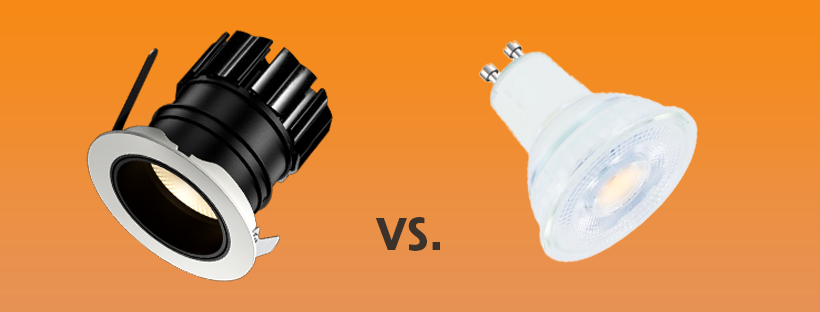
The quality of the light created is where the biggest difference is. The Orluna Dino uses a purpose-engineered LED module with a colour rendering of minimum 98 CRI (and their “Origin Natural” engine even higher), specifically tuned to render colour warmly and flatteringly. A typical 600lm GU10, even a “good” one, will likely be 80-90 CRI, and the spectral quality, particularly the red (R9) channel, will simply not match. In practice this means skin tones, fabrics, timber, and materials look noticeably less alive. This is the hardest thing to quantify on a spec sheet but the most visible difference to a client.
The Dino is a darklight with a double black baffle and is specifically engineered to hide the source and direct light downward with minimal glare. A budget GU10 downlight typically has a white or silver reflector and the lamp is visible from more angles, causing discomfort glare particularly in spaces with lower ceiling heights or where people are seated. This is a measurable UGR (glare measurement) difference and very noticeable in practice.
Lumen is the measurement of how much light leaves the luminaire or bulb. Using the Origin LED option in the Dino of 685lm vs GU10 high output bulb of 600lm is only about a 12% difference. Spacing your downlights correctly will compensate easily, so this is not where your trade-off lies.
A GU10 unless the most expensive, will come with a one size fits all beam width, usually 36°. This suits many applications, but arguably only with standard ceiling heights of between 2.2m and 2.8m. After that the light spreads widely at floor level and creates an overall washed effect. Orluna products are built to order, offering many choices of beam width to suit your space, allowing us to control where the light is distributed, creating constrast which is aesthetically more appealling.
Orluna products are engineered for smooth, flicker-free dimming to very low levels with warm dim behaviour on some models. GU10 bulbs are notoriously inconsistent on dimming, many flicker, drop out early, or don’t dim below 20-30%. If your project uses dimming (which most higher-end residential and hospitality projects do), this is potentially a significant practical difference.
Orluna have a 20-year spare parts and repair circular product policy and an end-of-life service where products can be returned to be repaired, and returned to you with a new warranty at a lower cost than buying a complete new product again. A GU10 bulb lifespan is much shorter, probably replaced in maybe 3-5 years, and the colour and output can drift as it ages. For a client who won’t want to revisit the ceiling in a decade, this matters.
The Dino has a slimline bezel and a clean, contemporary darklight appearance. Budget downlights tend to have chunkier bezels, less refined apertures, and simply not designed as well. There are a few exceptions to this which we can help you source, but overall there is a feel of lower quality with a GU10 lamped fixture, especially in close proximity.
Where the GU10 route makes sense: back-of-house, plant rooms, utility areas, rental property where durability and replaceability trump quality, or projects where there isn’t the budget. The cost saving is real with Orluna Dino units typically £100 to £150+ per fitting depending on configuration versus £15 to £40 for a decent GU10 downlight with lamp. On a whole house project that’s a meaningful number.
If you are choosing for a kitchen, living room, retail, hospitality, or any space where how things look matters to the end user, the Orluna Dino will be visibly better and the difference will be very apparent to you even if you can’t articulate why. The CRI gap and glare control alone justify the cost in premium residential or design-led commercial work. If budget is truly the constraint, a mid-market fixed-wired LED downlight from a reputable brand (speak to us) with a good CRI module would be a more defensible middle ground than a GU10, as you’d at least preserve the optical and dimming quality to some degree. Despite the GU10 falling short, it can be a wise budget conscious choice for less important areas.

We ask if solar lighting is good enough now for designers to use confidently – with test example garden.

Let lighting design be simpler with the resources of Orange Lighting behind you. Successful design implementation is dependant upon the people around you.

Andrew Orange writes for Darc Magazine 2014, on the incredible material of porcelain that transforms any space by bathing it in a convivial honey like glow

Spare a few moments and learn from a designers top 5 tips on how to improve your kitchen’s lighting.

Learning how to use and choose in-ground uplighters will enhance any lighting scheme. Quick tips on how, where and what to specify for LED in ground uplights.